


European project for strengthening leadership, civic participation, and inclusive decision-making
INCLUDE: Inclusive Leadership and Democratic Participation of Persons with Disabilities is a 24-month European project, supported through the European Union’s Citizens, Equality, Rights and Values (CERV) programme.
The project is implemented in partnership with seven organizations and local authorities from six European countries: MOVEO from Austria (coordinator), Proportional Message from Portugal, the Municipality of Mesagne from Italy, Kunsill Lokali ta’ l-Imġarr and Skills Zone Malta from Malta, Zavod ODTIZ from Slovenia, and the Association “Equality” (Ikualiti) from Macedonia.
What is the goal?
The main goal of INCLUDE is to create more opportunities for persons with disabilities to actively participate in public and democratic life, to take on leadership roles, and to influence decisions that affect them.
Although the rights of persons with disabilities are recognized in laws and international documents, their representation in institutions, local councils, working groups, and decision-making processes remains limited.
Therefore, INCLUDE is founded on the principle “Nothing about us without us,” promoting a transition from formal inclusion to meaningful participation, in which persons with disabilities are recognized as active citizens, advocates, experts, and leaders.
What will be implemented?
The project encompasses several interconnected activities:
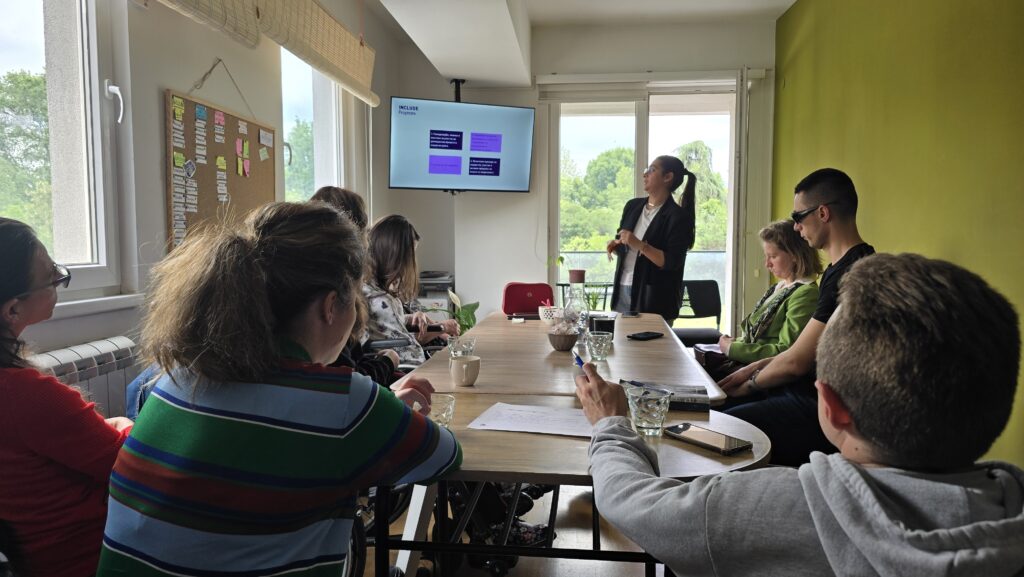
- Research and Focus Groups – In the partner countries, research will be conducted into the barriers, experiences, and good practices regarding the participation of persons with disabilities in public life. Through focus groups, persons with disabilities themselves will share their needs, views, and suggestions for improvement. Through consultations with stakeholders—including representatives from municipalities, institutions, civil society organizations, and other relevant actors—institutional challenges and opportunities for improvement will be examined. By connecting the two perspectives, realistic and applicable solutions will be identified, which will serve as a basis for developing the Handbook on Inclusive Representation and the enhancement of local practices for democratic participation.
- Handbook for Inclusive Representation – Based on research and consultations, a practical, accessible, and multilingual toolkit will be developed, containing guidelines and recommendations for municipalities, institutions, and civil society organizations, with the aim of better including persons with disabilities in decision-making processes.
- Leadership Training and Mentorship – Accessible training sessions will be organized to develop skills in leadership, self-advocacy, public speaking, civic participation, and communication with institutions. Special attention will be given to women and young people with disabilities.
- Workshops, conferences, and public campaigns – Through local and international events, project results will be promoted, experiences will be exchanged, and cooperation will be fostered among persons with disabilities, local authorities, institutions, and the civil sector.
Who is the project intended for?
Persons with disabilities: An opportunity to share their experiences, participate in creating practical solutions, develop leadership skills, and gain greater visibility and space to exert influence within the community.
Municipalities and institutions: An opportunity to better understand existing barriers, collaborate directly with persons with disabilities, and acquire practical tools for organizing accessible consultations and more inclusive decision-making processes.
Civil society organizations and professionals: An opportunity to exchange experiences, improve their own practices, and utilize project materials in future initiatives.
Why get involved?
Inclusive policies create better institutions, higher-quality services, and stronger local communities.
By participating in INCLUDE, municipalities, institutions, and civil society organizations gain the opportunity to:
- To recognize the real needs of persons with disabilities through direct dialogue and cooperation.
- To acquire practical tools and knowledge for improving accessibility, civic participation, and local policies.
- To exchange European experiences and good practices with partners from six countries.
- To strengthen citizens’ trust through more open, accountable, and inclusive decision-making.
- To create sustainable solutions that will continue to yield benefits even after the project ends.
Persons with disabilities gain the opportunity for:
- Strengthening leadership and advocacy skills through training, mentorship, and practical tools for active participation in society.
- Greater involvement in decision-making processes, with the opportunity for their views, needs, and experiences to be heard and taken into account.
- Better opportunities for self-advocacy and representation within local communities, institutions, and civil society organizations.
- Developing self-confidence, knowledge, and new skills for taking on active and leadership roles.
- Connecting and exchanging experiences with other persons with disabilities, advocates, and organizations from various European countries.
Getting involved with INCLUDE is more than just supporting a project—it is an opportunity to become part of a positive change, where persons with disabilities are active participants, leaders, and agents of change, and where institutions develop more inclusive policies and practices that better serve all citizens.
