


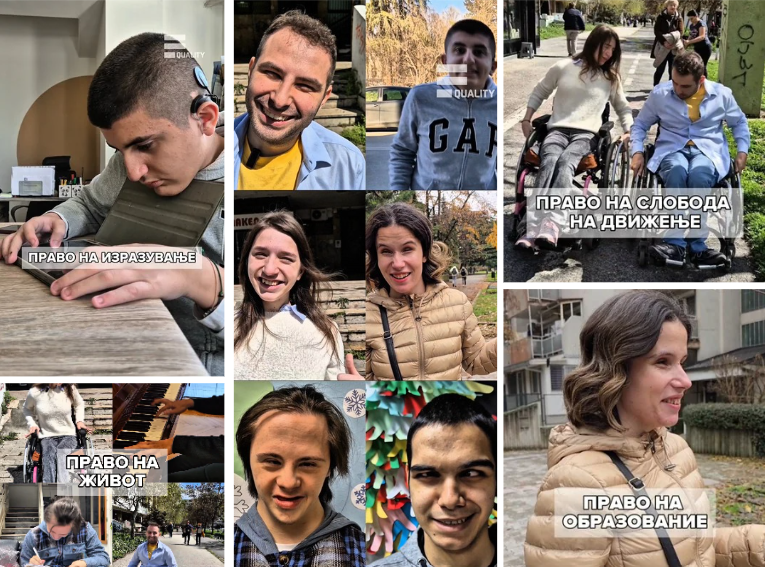
Every person has the right to education, expression, freedom of movement, participation in cultural life, and a life with dignity. But to what extent are these rights accessible to persons with disabilities in their daily lives?
As part of the project “Fundamental Human Rights in the Post-COVID Contemporary Reality: Challenges – Solutions – Concrete Changes,” the Association “Equality,” with financial support from the Municipality of Gazi Baba, produced a series of five mini-documentary videos focused on fundamental human rights and the challenges faced by persons with disabilities.
Through authentic personal stories, experiences, and everyday situations, campaign participants reveal the barriers that limit the realization of their rights, while also highlighting the importance of equal opportunities, independence, and a life with dignity.
Five videos – five fundamental human rights
EMA HAS A RIGHT TO EDUCATION!
Education is a fundamental human right and an opportunity for every person to develop their talents and potential.
Ema shares her story about the challenges she faced during her education, as well as the dedication and perseverance that enabled her to achieve her dream—to become a successful pianist.
Her story serves as a reminder that talent knows no disability, but that its development requires accessible education, appropriate support, and equal opportunities.
STEFAN HAS THE RIGHT TO EXPRESSION!
Every person has the right to express their views, feelings, and needs, regardless of the mode of communication.
Stefan is a non-verbal individual who, during his primary education, faced serious challenges due to the educational staff’s lack of preparedness to understand and address his needs.
His story highlights the importance of alternative forms of communication, as well as the need for professional and trained staff who will create conditions for the development and progress of every child.
Communication is not limited to speech alone. Every person has their own way of expressing themselves and the right to be understood.
JOVANA AND MIKI HAVE THE RIGHT TO FREEDOM OF MOVEMENT!
Freedom of movement must not be restricted due to inaccessible infrastructure, public transport, or institutions.
Jovana faces daily barriers when using bus and rail transport, which limit her independence and her ability to move around freely.
Miki, meanwhile, faces inaccessibility at a polling station located in a school, which prevents him from exercising his right to vote independently.
Their experiences show that inaccessibility is not merely a physical barrier. It directly affects the realization of other fundamental rights as well—participation in social and political life, safety, and equality.
Accessibility is not a privilege, but a prerequisite for freedom and equal participation.
DENIS AND NIKOLA HAVE THE RIGHT TO PARTICIPATE IN CULTURAL LIFE!
Culture, art, entertainment, and socializing should be accessible to everyone, without exception.
Denis and Nikola, members of the Association for Persons with Down Syndrome – Day Center “Dose of Happiness,” convey the importance of active participation in cultural and social life through their energy, joy, and natural, open manner.
Their participation in the campaign serves as a reminder that inclusion entails the opportunity for every person to be present, visible, accepted, and actively involved in the community.
Culture belongs to everyone, and diversity makes it richer.
EVERY HUMAN BEING HAS THE RIGHT TO LIFE!
The final video brings together the participants and the messages from the campaign, emphasizing that the right to life is the most fundamental human right, and that a dignified and safe life belongs to every person—regardless of disability, gender, age, or any other form of diversity.
The joint message points out that discrimination and the failure to respect the right to education, expression, movement, and cultural participation directly affect the quality of life and the opportunity to function on an equal footing within society.
Human rights are universal, indivisible, and equally important for everyone. Respecting them must not be an exception, but the rule.
From Personal Experiences to Social Change
Through the implementation of this campaign, the Association Equality created a space for persons with disabilities to present their own experiences, challenges, and needs, rather than having others speak on their behalf.
The five mini-documentary videos aim to raise public awareness, challenge social prejudices, and encourage greater responsibility among institutions and the community for ensuring equal opportunities.
The stories of Ema, Stefan, Jovana, Miki, Denis, and Nikola remind us that behind every violated right stands a person whose freedom, autonomy, and dignity are restricted.
Therefore, real change begins when human rights cease to be merely guaranteed in principle and become truly attainable for everyone.
The project “Fundamental Human Rights in the Post-COVID Contemporary Reality: Challenges – Solutions – Concrete Changes” was implemented by the Association “Equality in 2024, with financial support from the Municipality of Gazi Baba.
